Overview of Bottom-blowing porous plugs
Since the 1960s, ladle secondary refining processes have been adopted by steelmakers. Operational experience has demonstrated that effective inert gas treatment is essential for successful secondary refining in the ladle. Initial inert gas stirring relied on top-blown argon lances; however, this method had significant limitations, particularly in effectively stirring the molten steel near the ladle bottom. In contrast, bottom gas injection intensifies bath stirring, facilitating the removal of non-metallic inclusions, purifying the molten steel, and homogenizing its composition and temperature. Domestic adoption of porous plugs for secondary refining began in the 1970s, and by the 1990s, argon bottom-blowing using porous plugs had become a key metallurgical practice in the steel industry.
Metallurgical functions of porous plugs
The ladle purging plug is a critical functional component in the secondary refining process, serving the following primary functions:
(1) It regulates the temperature distribution of the molten steel within the ladle, ensuring the optimal casting temperature for the process.
(2) It facilitates the uniform distribution of alloying elements and deoxidizers within the ladle through gas-injection stirring.
(3) It transports non-metallic inclusions from the molten steel into the slag, thereby achieving the required level of steel cleanliness.
To achieve these functions, inert refining gas is injected into the ladle through the purging plug. At the interface between the plug and the molten steel—specifically the plug’s working face—sufficient pressure forces a large volume of gas bubbles out to form a gas jet stream. This stream stirs the molten steel throughout the ladle, promoting flow and homogenizing both temperature and composition. Simultaneously, the continuously rising bubbles transport non-metallic inclusions from the steel into the slag, effectively purifying the molten steel.
Properties required for ladle permeable bricks
To fulfill the aforementioned metallurgical functions, gas-purging bricks must possess the following key properties:
(1) Good gas permeability. Permeability is a critical parameter for assessing the quality of gas-purging bricks. Research indicates that the stirring energy imparted to the molten steel is directly proportional to the flow rate of the injected gas; stirring energy directly dictates stirring efficiency, and sufficient energy is required to achieve effective agitation of the molten steel. For a given argon flow rate, a higher number of injected argon bubbles enhances both degassing and stirring performance.
(2) High-temperature corrosion resistance. Refining ladles operate under stringent temperature and duration requirements; peak temperatures often exceed 1750°C, and refining cycles can last for tens of minutes. During refining, slag basicity significantly impacts the service life of the gas-purging bricks. Consequently, these bricks are susceptible to rapid degradation caused by highly penetrative basic slag at elevated temperatures.
(3) High-temperature wear resistance. During bottom argon purging, the rapid flow of molten steel within the ladle intensifies the erosive wear on the lining materials, the bottom gas-purging bricks, and the seating blocks. During hot maintenance, oxygen blowing is employed to clean residual steel and slag from the brick surface and restore permeability by melting the adhered material; simultaneously, gas is injected through the brick to blow away the molten slag. This cleaning process subjects the brick to high-velocity gas streams, necessitating excellent high-temperature wear resistance.
(4) Good thermal shock resistance. Ladles operate intermittently; when molten steel is poured in, the brick face is exposed to high temperatures, causing a sudden rise, while the injection of argon provides cooling, generating significant internal thermal stress. Furthermore, the introduction of molten steel into an empty ladle induces drastic temperature fluctuations. These harsh operating conditions make the bricks highly susceptible to thermal spalling and structural spalling.
(5) Ease of installation, safety, and reliability. The porous plug is installed within the bottom well block of the steel ladle. Due to the extremely harsh operating conditions, the service life of the porous plug does not match that of the ladle itself, necessitating periodic replacement. Consequently, the installation process must be simple, and the operation safe and reliable, to prevent incidents such as steel seepage or leakage.
Structural Evolution of Ladle Permeable Bricks
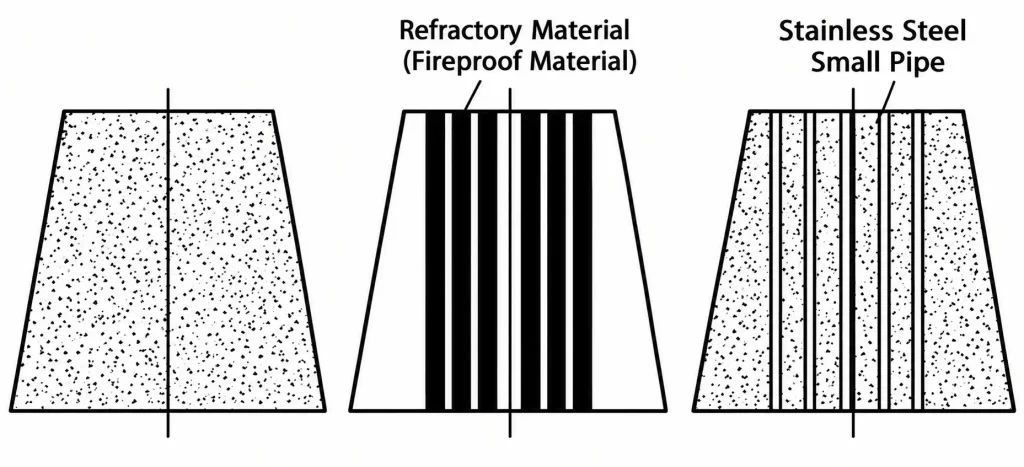
After years of development, there are three main structural types of gas-permeable bricks: the diffuse type, the slit type, and the straight-through hole type.
The diffuse type was the earliest form of gas-permeable brick. Due to the material’s high inherent porosity, the numerous pores provide channels for inert gas flow. However, this type suffers from low strength and poor erosion resistance; it is susceptible to penetration by molten steel and slag—leading to spalling—and offers relatively poor stirring efficiency. Consequently, it is rarely used in ladle gas-permeable bricks in China today.
Slit-type gas-permeable bricks come in two forms. The first involves assembling several shaped thin plates in the center to form slits, with the outer section cast from refractory material; this is known as the “assembled-slit” type. Its main drawback is poor control over the injected gas. The second form features dozens of straight slits pre-cast directly into the brick body; this is the standard “slit-type” brick. Compared to the assembled-slit version, this type offers advantages such as a longer service life, a higher gas-blowing success rate, greater gas flow, and superior stirring performance.
Straight-through hole gas-permeable bricks are manufactured by embedding a number of fine steel tubes into the brick body, creating gas channels composed of many straight, microscopic conduits; they are formed using a casting process. Compared to diffuse-type bricks, they provide better stirring performance and a service life that is two to three times longer. However, they have the disadvantage of limited gas flow capacity; in the later stages of use, refining often fails because the gas permeability decreases or the channels become blocked.
Selection of Porous Plug Installation Methods
The configuration of porous plugs is determined by the volume of molten steel in the ladle, the stirring requirements dictated by the steel grade and process route, and the specific objectives of the ladle treatment. The placement of the bottom-blowing gas assembly depends on the intended purpose of the treatment. Installing the porous plug at the center of the ladle bottom versus at an off-center position (typically at a radius of 1/2 to 1/3 from the center) yields different stirring effects: central argon blowing promotes reactions between the slag and the steel, particularly desulfurization by the top slag, whereas off-center blowing enhances internal mixing, temperature homogenization, and the flotation of inclusions. For instance, in CAS/CAS-OB processes, the porous plug must be installed at the center of the ladle bottom to allow argon to displace the slag layer beneath the immersion snorkel, thereby facilitating alloying or oxygen injection. Conversely, the LF (Ladle Furnace) process requires the plug to be positioned near the furnace door to accommodate operations such as carburization, alloying, and deoxidation. A greater number of porous plugs results in more fine bubbles, leading to more effective inclusion removal and superior steel quality; however, increasing the number of plugs also raises the risk of steel breakouts. Typically, a single porous plug suffices for ladles with a capacity of less than 70 tons, while two plugs are required for ladles exceeding 70 tons.
Porous plugs can be installed using either an internal or an external mounting method. The internal method involves pre-assembling the porous plug with its seating block outside the ladle; during the lining process, the installation site on the ladle bottom is prepared, and the assembled unit is hoisted into position after the surrounding bricks are laid, followed by the completion of the bottom and sidewall linings. The external mounting method utilizes a combination of a seating block, a sleeve brick, and the porous plug itself. When lining a steel ladle, the bottom and sidewalls are constructed after the well block has been installed at the ladle base. Finally, refractory mortar is evenly applied to the exteriors of the sleeve brick and the porous plug; these are then firmly inserted into the well block in sequence. Next, a base brick is placed beneath them, the flange is secured, and the assembly undergoes preheating. Internally installed porous plugs are used when the service life of the porous plug matches that of the ladle lining bricks, whereas externally installed versions are suitable for situations requiring frequent plug replacement. Due to the lower safety, poor reliability, and cumbersome replacement process associated with internally installed porous plugs, almost all steel ladles currently utilize externally installed porous plugs.
Materials and Application of Porous Plugs
Currently, the materials used for gas-permeable bricks include corundum, chrome-corundum, high-alumina, and magnesia-chrome.
A Corundum-Spinel System Gas-Permeable Plug
Monophasic corundum-based castables exhibit suboptimal slag and thermal shock resistance, whereas spinel materials offer excellent resistance to slag erosion. Applying the principle of multiphase modification to enhance refractory performance, high-purity fused spinel is incorporated into corundum castables to improve their properties. The raw materials consist of tabular corundum as the aggregate; fused white corundum, spinel, and reactive α-Al₂O₃ micropowder as the fines; and calcium aluminate cement as the binder. While this approach significantly improves thermal shock and slag resistance, a drawback arises during high-temperature processing: the volumetric changes associated with spinel compromise the dimensional stability of the porous plugs, making production control difficult.
B Corundum-Chromium Oxide System Gas-Permeable Plug
To further enhance the resistance of gas-purging bricks to steel slag erosion, a certain amount of chromium oxide micropowder is incorporated into the product. The primary raw materials consist of tabular alumina (as granular aggregate), tabular alumina fines and chromium oxide micropowder (as fine powder), and calcium aluminate cement (as the binder). At high temperatures, chromium oxide and aluminum oxide form a high-temperature solid solution; simultaneously, they form a partial solid solution (MgO·Cr2O3–MgO·Al2O3) with a small amount of magnesium oxide. This solid solution exhibits significantly enhanced resistance to erosion by Fe2O3 or slag and possesses high viscosity, thereby effectively inhibiting the penetration and erosion of steel slag at high temperatures. Furthermore, a small amount of Cr2O3 inhibits excessive Al2O3 grain growth and reduces intra-crystalline stress, thereby improving the material’s physical properties. However, excessive addition overly inhibits corundum grain growth, generating internal stress that degrades the material’s physical properties. Additionally, Cr2O3 is relatively expensive, so excessive use significantly increases costs; it also causes serious environmental pollution.
C Corundum-Spinel System Gas-Purging Plug
Corundum-spinel porous plug bricks are the most widely used type; they are primarily composed of tabular corundum, α-Al₂O₃ micropowder, and spinel, bonded with pure calcium aluminate cement. Their advantages stem from the fact that spinel is a high-melting-point compound with strong resistance to both acids and alkalis, resulting in excellent overall performance. Magnesium-aluminum spinel exhibits strong resistance to alkaline slag and maintains stability in the presence of iron oxides; specifically, it reacts with magnetite at high temperatures to form a solid solution, thereby enhancing the brick’s high-temperature corrosion resistance. Furthermore, spinels containing solid-solution MgO or Al₂O₃ offer superior thermal shock resistance due to differences in the thermal expansion coefficients of the constituent minerals. However, a drawback is that the formation of spinel according to the theoretical stoichiometric ratio involves a volume expansion of approximately 8%, making densification during firing difficult and complicating the control of volume changes in the finished bricks.
D Corundum-Chromium Oxide System Gas-Permeable Block
Corundum-chromium oxide porous plug bricks were developed based on the corundum-spinel system to enhance high-temperature spalling resistance. Their primary raw materials include tabular corundum, α-Al₂O₃ micropowder, industrial-grade chromium oxide, and spinel, bonded with pure calcium aluminate cement. Their advantages lie in the fact that, building upon the performance improvements provided by spinel, the formation of an Al₂O₃-Cr₂O₃ solid solution significantly boosts resistance to iron oxide slag erosion; furthermore, the addition of a small amount of Cr₂O₃ inhibits excessive alumina crystal growth, thereby reducing internal crystal stress and improving the brick’s thermal shock resistance, erosion resistance, and resistance to scouring. However, there are drawbacks: excessive Cr₂O₃ addition severely affects corundum grain growth rates, thereby degrading the material’s physical properties; additionally, Cr₂O₃ causes significant environmental pollution, conflicting with national sustainable development requirements.
Damage mechanism of porous plugs
The operation of porous plugs is intermittent, resulting in varying forms of physical and chemical erosion at different stages of the ladle’s service cycle. In practice, the degradation of porous plugs can be categorized as follows:
(1) Oxygen-burning and purging effects
After tapping is completed and before the ladle receives its next charge, it undergoes hot repair. During this stage, oxygen is used to burn and purge the working face of the porous plug to remove residual steel and slag. While this measure benefits the plug’s operation by ensuring a clean working face and unobstructed gas channels—thereby facilitating smooth ladle turnover—it carries risks. Because it is difficult to accurately gauge the thickness of residual steel and slag on the plug’s working face during hot repair, the plug itself may be inadvertently burned away during the cleaning process. This issue is exacerbated if the ladle bottom is in poor condition or if the operator makes a misjudgment; oxygen burning generates temperatures exceeding 2000°C, and this high-temperature gas flow is highly destructive to the porous plug, often causing 2 to 3 times more erosion in just a few minutes than occurs during standard refining operations.
(2) Mechanical wear effects
The high-speed, forceful scouring of the ladle bottom by molten steel during tapping accelerates the erosion of the porous plug. Hydraulic model studies have revealed that when a low-velocity gas stream enters the molten bath, the gas rebounds and strikes the leading edge of the porous plug, exerting impact force on the refractory material surrounding the gas outlet. Increasing the gas flow velocity reduces the frequency of reverse pulses but intensifies the reverse impact force. Furthermore, when argon injection reaches a steady state, intense bubbles form a gas jet stream that enhances stirring at the ladle bottom and intensifies the movement of the molten steel; the resulting two-phase turbulent flow subjects the porous plug to severe shear and impact stresses. This shear and scouring effect is particularly pronounced when the porous plug protrudes above the surrounding well block; the protruding section is often eroded away after just a single use, a scenario that frequently occurs with newly installed plugs. Additionally, rapidly closing the valve after refining concludes can cause a back-surge of molten steel that further accelerates damage to the porous plug. (3) Effect of thermal stress
The refractory material on the working face of the porous plug—particularly the area surrounding the gas outlet—comes into direct contact with molten steel at high temperatures. It is subjected to the combined influence of the hot steel and the continuous flow of cool gas, resulting in steep temperature gradients. Repeated use exposes the plug to cycles of rapid heating and cooling; the thermal stress is particularly severe near the gas outlet, making the material prone to circumferential cracking and subsequent fracture.
(4) Chemical erosion
The working face of the porous plug remains in prolonged contact with slag and molten steel. Throughout the service life of the ladle, molten slag continuously infiltrates and permeates the brick. Oxides present in the molten steel and slag—such as MnO, MgO, SiO2, FeO, and Fe2O3—react with the brick material:
12CaO+7Al2O3═12CaO·7A1203
FeO+Al2O3═FeO·Al2O3
2MnO+SiO2+Al2O3═2( MnO)·SiO2·Al2O3
Low-melting-point substances such as FeO·Al₂O₃, 2(MnO)·SiO₂·Al₂O₃, and 12CaO·7Al₂O₃ are formed and subsequently washed away, causing erosion of the porous plug.
Ways to Extend the Service Life of Porous Plugs
(1) Incorporating zirconium-based materials and tabular corundum to improve the spalling resistance of gas-purging bricks.
Adding pre-synthesized zirconium-based materials modifies alumina-chromia gas-purging bricks. The difference in linear thermal expansion coefficients between corundum-based materials and zirconium-based materials leads to the formation of micro-cracks at high temperatures; these micro-cracks absorb and dissipate some of the energy from major cracks, thereby reducing stress concentration, inhibiting crack propagation, and enhancing the toughness of the brick. Utilizing the toughening effect of ZrO2 through the addition of pre-synthesized zirconium-based materials significantly improves the thermal shock resistance of the bricks. Tabular corundum is a sintered alumina raw material produced without additives such as MgO or B2O3 and characterized by thorough shrinkage; its phase composition consists of hexagonal tabular α-Al2O3 crystals with a median diameter of 20–40 μm, featuring a microstructure of plate-like crystals that interpenetrate and interlock. During rapid sintering, the coarse crystals formed by the recrystallization of sub-micron α-Al2O3 encapsulate spherical, closed pores measuring 5–15 μm. Consequently, tabular corundum possesses high strength, imparting excellent thermal volume stability and good thermal shock resistance to the gas-purging bricks. Reducing impurity content enhances erosion resistance; during high-temperature oxygen lancing to remove steel slag from the brick surface, the slag tends to react with the refractory material at high temperatures, creating erosion pits. Higher impurity levels in the refractory material lead to more severe erosion from oxygen lancing; therefore, minimizing impurities is essential to improve the brick’s high-temperature performance. Impurity levels are reduced by selecting raw materials with low R2O content and minimizing the amount of cement in the castable used for the bricks. Lower cement content results in reduced CaO levels and less formation of the low-melting-point phase gehlenite (calcium-aluminum melilite), thereby improving refractoriness and enhancing resistance to both oxygen lancing and slag erosion.
(2) Optimization of ultrafine powders.
To increase the strength of the gas-purging bricks, α-Al2O3 micropowder is used as a binder and serves as one of the primary raw materials. At high temperatures, α-Al₂O₃ micropowder promotes material sintering and increases the strength of the porous plug, thereby enhancing its resistance to oxygen purging.
(3) The stirring intensity of the molten steel is directly proportional to the argon flow rate.
A greater number of bubbles emerging from the slits results in higher stirring intensity, which is more conducive to degassing the molten steel; therefore, the selection of the slit width is crucial. If the slits are too narrow, the gas flow may be insufficient to open the channels during operation, failing to induce the necessary stirring action. Conversely, if the slits are too wide, the resulting large bubbles reduce stirring efficiency, and the increased risk of steel penetration can block the channels, preventing the plug from being reopened for subsequent use. Slit width is fundamental to the stable performance of the porous plug. The choice of width primarily depends on the relationship between the molten steel depth and the risk of steel penetration; when the steel depth exceeds 2 meters, the slit width must be less than 0.15 mm to prevent penetration.
(4) Uniform material distribution improves the volumetric stability of the porous plug.
During the forming process, the distribution of the castable material directly affects the plug’s volumetric stability. Because the slits are arranged in a staggered pattern with varying spacing, vibration molding can cause aggregates or fine powders to cluster. This leads to uneven volumetric changes during service, where fluctuations in slit width can result in the plug failing to open or experiencing steel penetration. Two solutions address this: first, optimize the fluidity of the castable by strictly controlling water addition to prevent segregation during vibration molding; second, securely fix the slit-forming inserts to ensure uniform material distribution and prevent shifting, which could otherwise create localized narrow spots that impede material flow.