
Permeable bricks are crucial functional components in the bottom-blown argon process of secondary refining in steel ladles. They possess both metallurgical functions of homogenizing and purifying molten steel. On one hand, the stirring effect of argon gas helps to homogenize the temperature and composition of molten steel in different parts of the ladle. On the other hand, utilizing the principle of a vacuum pump, the surface of argon bubbles adsorbs fine non-metallic inclusions such as Al₂O₃, SiO₂, and MA, while the interior of the bubbles draws in harmful gases such as nitrogen, hydrogen, and oxygen from the molten steel. As the bubbles rise, they gradually converge and grow, eventually being captured by the slag layer. Therefore, permeable bricks are indispensable key refractory materials for clean steelmaking, and their service performance directly affects the purity of the molten steel. Furthermore, the service life of permeable bricks is one of the bottlenecks restricting the lifespan of steel ladle maintenance; stable service life is a prerequisite for ensuring smooth ladle production. Therefore, this paper briefly reviews the material changes and structural evolution of steel ladle permeable bricks, analyzes the structural characteristics and metallurgical functions of three types of composite permeable bricks: dispersion type, core plate type, and ceramic tube type, and focuses on elucidating the damage mechanism of composite permeable bricks.
1.Structural evolution of permeable bricks
1.1 Single-structure permeable brick
In the 1960s, the first type of dispersed permeable brick was invented. It applied the reverse of the particle compaction theory, using a large number of uniformly sized particles and introducing ablative materials to cleverly pre-fabricate numerous non-directional, interconnected pores. The brick was formed by hydraulic or vibratory pressing, and due to the limitations of the forming method, its height generally did not exceed 270 mm. Because high-alumina or magnesia dispersed permeable bricks have poor erosion resistance and limited height, they could not meet service life requirements. In the 1980s, through-hole permeable bricks were introduced. Several stainless steel tubes with a diameter of 1–3 mm were pre-embedded inside the brick, which was then cast. Its service life was longer than that of the dispersed type. Entering the 1990s, following the trend of amorphous refractory products, the introduction of ultrafine powders and high-efficiency dispersants led to the superior performance of low-cement chromium corundum castables. Straight-hole permeable bricks gradually decreased in bottom-blown argon ladle applications, eventually being replaced by slotted permeable bricks made from corundum-spinel or chromium corundum castables. Slots were constructed using polyester film sheets with a thickness of 0.15–0.25 mm after high-temperature ablation.
Permeable bricks with single-channel structures such as dispersed, straight-hole, and slotted types (see Figure 1 for a schematic diagram) are difficult to universally apply to various smelting conditions. In particular, traditional dispersed and straight-hole types have been phased out of the ladle permeable brick market. In practical applications, single-structure permeable bricks often exhibit insurmountable defects: high-temperature fired slotted permeable bricks have poor thermal shock resistance, and thermal stress is concentrated within 50mm of the working surface. When subjected to frequent rapid cooling and heating shocks, longitudinal and transverse cracks are easily generated. After molten steel seeps into the slots and cross-sections, the flow rate decreases or even becomes impermeable. Traditional dispersion-type permeable bricks have low density, poor resistance to molten steel erosion and wear, poor resistance to oxygen cleaning, and short service life. Furthermore, traditional one-piece molded dispersion-type bricks cannot be designed with safety alarm devices.
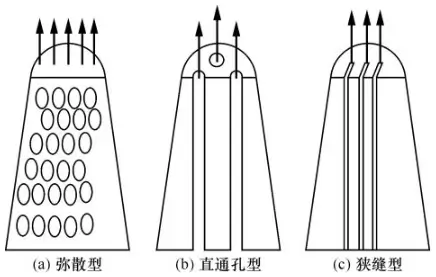
1.2 Composite Structure Permeable Brick
Composite air duct structures allow different types of permeable bricks to complement each other’s advantages and mitigate their disadvantages. Currently, the most technologically mature composite permeable bricks on the market can be divided into three main categories based on their primary air duct structure: dispersion type, core plate type, and ceramic tube type. Differentiated market demands are driving the development of single-structure permeable bricks towards composite structures. Dispersion-type composite permeable bricks are favored by steel mills in Japan, South Korea, and Vietnam; core plate-type composite permeable bricks are widely used in steel mills in Europe, the United States, and the Middle East; and ceramic tube-type composite permeable bricks are highly praised by steel mills in Russia and other regions.
All three types of composite permeable bricks possess unique performance characteristics unmatched by single-structure permeable bricks: 1) The diffused composite permeable brick produces smaller bubbles than the slotted permeable brick, resulting in a greater number of bubbles at the same flow rate. This significantly increases the probability of collisions with non-metallic inclusions and harmful gases, improving the efficiency of adsorbing fine inclusions and absorbing harmful gases, making it a preferred solution for smelting high-quality clean steel; 2) Due to the energy release space created when the plate-shaped core panels are spliced and the low expansion rate of corundum-mullite material, the core-plate permeable brick possesses excellent thermal shock resistance, thus avoiding the fatal defect of transverse fracture and steel seepage in high-temperature fired slotted permeable bricks, ensuring a high blowing rate; 3) The ceramic tube composite permeable brick combines the high flow rate characteristics of slotted bricks with the small-diameter bubbles of straight-through micropores.
The oxygen purging intensity and frequency of the three types of composite permeable bricks are much lower than those of traditional high-temperature fired slotted permeable bricks. Oxygen purging results in harsh working conditions for workers, with abundant smoke and dust, and significant environmental pollution. With rising labor costs and increasing environmental awareness, the advantages of light firing and no firing are becoming increasingly prominent. Oxygen purging is a double-edged sword for the permeability and service life of permeable bricks. While oxygen purging ensures the restoration of permeability, it inevitably damages the brick body, leading to excessive corrosion. The oxygen purging resistance of different structural types of permeable bricks is ranked as follows: traditional high-temperature fired slotted permeable bricks > ceramic tube composite permeable bricks > core board composite permeable bricks > dispersion composite permeable bricks. Conversely, the necessity, intensity, and frequency of oxygen purging are ranked as follows: traditional high-temperature fired slotted permeable bricks < ceramic tube composite permeable bricks < core board composite permeable bricks < dispersion composite permeable bricks. Of course, if the permeable bricks can self-circulate in the next smelting cycle and the flow rate reaches the set value, cleaning is unnecessary.
When designing composite permeable brick structures, the principles of “functional zoning, maximizing strengths and minimizing weaknesses, and complementary advantages” should be followed. Composite air duct structures can be achieved in both the longitudinal and transverse dimensions: 1) Longitudinally, the working layer and safety layer of the permeable brick are divided according to different functions. The working layer focuses on thermal shock resistance, erosion resistance, and scour resistance, while the safety layer focuses on high-temperature visibility and sufficient flow supply. The casting body provides structural support and fixes the permeable elements. The most suitable air duct structure and refractory material are selected for different parts to maximize essential functions while avoiding excessive design for secondary functions, fundamentally solving the problem of local overperformance and underperformance in single-structure permeable bricks; 2) Transversely, various different air duct structures can be selected within the working layer of the permeable brick to comprehensively consider bottom blowing flow rate, bubble quantity, bubble diameter, and impermeability. Figure 2 shows schematic diagrams of different types of composite structure permeable bricks. Depending on lifespan and performance requirements, more air duct combinations can be derived. As shown in Figure 2, both the dispersion type and the ceramic tube type have additional slits in the working layer to compensate for insufficient flow from the dispersion element and the ceramic tube permeable element. However, the number and layout of the slits differ, resulting in different contributions of the slits to the flow rate.
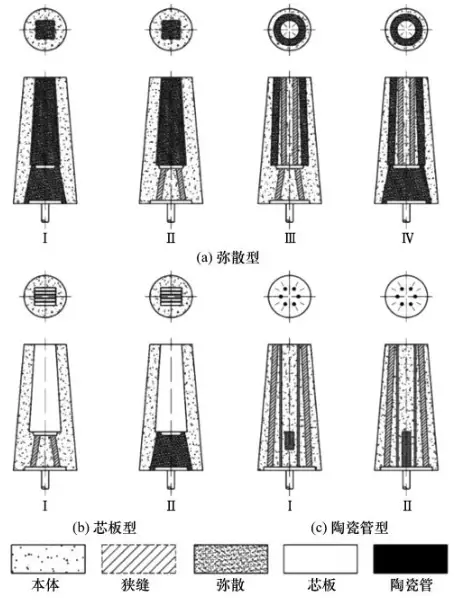
2. Damage Mechanism of Composite Structure Permeable Bricks
2.1 Dispersion-type composite structure permeable brick
Dispersion-type composite permeable bricks are generally based on the Al₂O₃-SiO₂-Cr₂O₃-ZrO₂ system. The aggregates are typically tabular corundum and white corundum particles (<1 mm), and the matrix is often composed of Al₂O₃ micro powder, Cr₂O₃ micro powder, ZrO₂ fine powder, or zircon fine powder. Common binders include aluminum dihydrogen phosphate, polyvinyl alcohol, and aluminosilicate sol. They are formed using isostatic pressing, hydraulic pressing, or vibration pressing methods, and then sintered at temperatures above 1650℃. When molten steel penetrates the dispersion brick to a shallow depth, residual steel in the pores can be blown out by high-pressure backflushing gas during backflushing. Alternatively, during the second tapping of steel, the working layer of the permeable brick is heated by the molten steel, and the melted residual steel is blown out by bottom-blowing argon gas. When the penetration depth is large, especially after multiple RH refining furnaces, the residual steel in the through-holes is difficult to blow out after condensation. It is necessary to use a high-pressure oxygen lance to purge and remove the penetration layer. At this time, ablation and scouring during oxygen lance cleaning of the permeable brick core are typical causes of damage to the diffuse permeable brick.
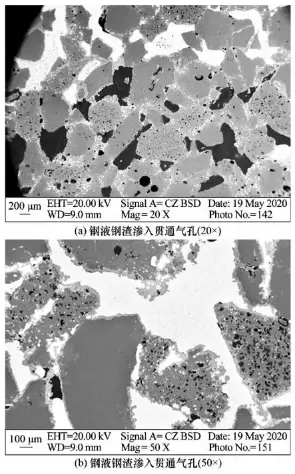
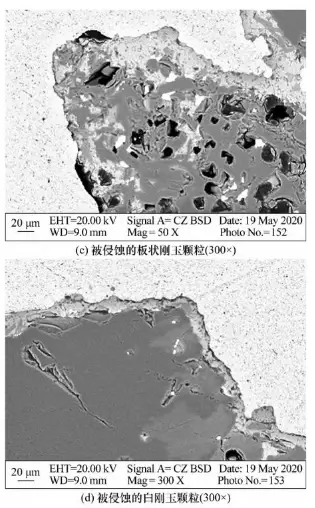
Figure 3 shows SEM images of the dispersed permeable brick fragments. It is evident that molten steel and slag preferentially penetrate the larger pores. The slag reacts with the corundum surface. In terms of reactivity, the reaction between molten steel and slag is more intense in tabular corundum than in white corundum due to its finer grains and more grain boundaries, as shown in Figures 3(c) and 3(d). Clearly, the primary damage mechanism of the dispersed permeable brick is the penetration of molten steel and slag into the interconnected pores, rather than the erosion of the matrix.
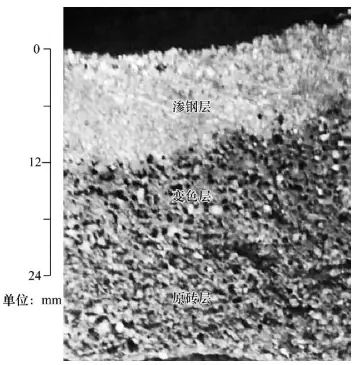
Figure 4 shows a photograph of a 300-ton refining ladle of a domestic steel plant. The layer 0-12 mm below the working surface is a steel-permeable layer, where the pores are blocked by steel, making it completely impermeable. The layer 12-18 mm below the working surface is a discoloration layer. After each heat of molten steel is cast, when the ladle enters the hot repair station and natural gas is backflushed, the steel-permeable layer prevents the backflushed natural gas from contacting air, causing it to fail to burn and crack at high temperatures, forming a black carbon deposit. Therefore, the steel-permeable layer must be removed by the high-pressure scouring and oxygen lance ablation of the permeable bricks in each heat cycle to ensure the next heat cycle can be reblown. Optimizing particle size distribution, reducing the proportion of large-diameter pores, narrowing the pore size distribution range, and improving the resistance of the dispersed bricks to the wetting and penetration of molten steel and slag, while minimizing the thickness of the steel-permeable layer and reducing the frequency of oxygen lance cleaning, are effective ways to improve the service life of dispersed composite permeable bricks.
2.2 Core-panel type composite structure permeable brick
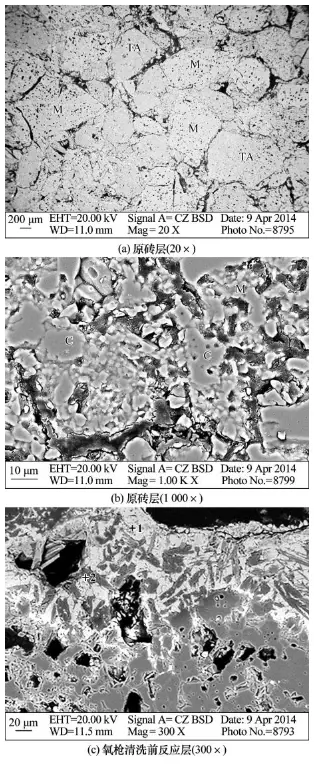
As shown in Figures 5(a) and 5(b), the main material of the core plate is corundum-mullite, with the aggregate mainly consisting of tabular corundum and sintered mullite fine particles (≤1mm). Due to the difference in thermal expansion coefficients, microcracks are generated around the two types of particles. The matrix is made of Al₂O₃ micro powder and SiO₂ micro powder. After high-temperature sintering, the mullite generated in situ in the matrix acts as a bonding phase, connecting the corundum and mullite particles. As shown in Figure 5(c) and Table 1, the bright parts (strips and dots) are iron-aluminum spinel generated by the reaction of small white corundum particles (1-0.5 mm, 0.5-0.1 mm) with molten steel (see point 1); the gray parts are the reaction of small mullite particles, the mullite matrix bonding phase, and CaO in molten steel and slag to generate low-melting-point aluminum-iron-silicon-calcium phases (see point 2), which are relatively easy to be washed away by oxygen during hot repair. Conventional corundum-mullite core plates readily form low-melting-point phases with CaO in steel slag. Cr₂O₃ and ZrO₂ can be introduced into the core plate to improve its resistance to molten steel and slag corrosion, reducing slag penetration and erosion. Alternatively, silicon-free materials, such as high-purity chromium corundum or high-purity corundum spinel, can be used to avoid introducing SiO₂ into the core plate without weakening its high-temperature mechanical properties and thermal shock resistance, thereby improving its resistance to steel slag corrosion.
2.3 Ceramic tubular composite permeable brick
The ceramic tubes are approximately 15–25 mm in diameter and contain dozens of through-holes with a diameter of 0.3–0.5 mm. A SEM image of the ceramic tubular permeable brick is shown in Figure 6.
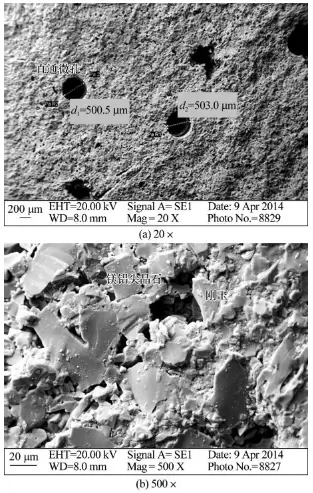
As shown in Figure 6, the micropores have a high degree of roundness, with a diameter of 0.5 mm. The main material of the ceramic tube is corundum-spinel, using tabular corundum and pre-synthetic spinel as raw materials, with the addition of a small amount of plasticizers such as soft clay and organic binders. It is formed by extrusion molding, followed by curing, drying, and high-temperature sintering. A small amount of liquid phase is present in the matrix. Figure 7 shows a photograph of a ceramic tube-shaped residual brick used in a 180t steel ladle at a foreign steel plant. It can be seen that the surface of the permeable brick is relatively flat, without residual steel residue. It can be inferred that the permeable brick body is transversely fractured, with four ceramic tubes broken along with it. The ceramic tubes are black. Because the permeable brick fractured during natural gas backflushing, the permeable channel was interrupted, and the backflushed natural gas could not come into contact with the oxygen injected in the oxygen lance. The natural gas underwent high-temperature cracking, producing residual carbon, hence the black color.
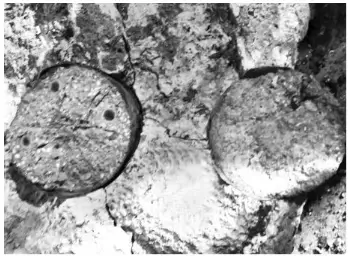
Therefore, improving the thermal shock resistance of the ceramic tubular permeable brick body is key to solving the damage problem. Furthermore, if the viscosity of the molten steel is low, it will penetrate into the through-holes under static pressure. When the penetration depth is large, the molten steel condenses, making it difficult to blow out during backflushing. Improving the resistance of the pore walls to molten steel wetting, or further reducing the pore size to below 0.2 mm, could potentially solve the problem of steel penetration into the through-holes.
3.Conclusion
The air duct structure of permeable bricks determines their permeability, which in turn affects metallurgical performance and service life. Regardless of the structural type, the key to production and use lies in the formation and maintenance of the air ducts (pores, channels, slits). Besides the quality of the materials, the performance of permeable bricks is also closely related to the air duct manufacturing process and the operational procedures used.
The damage mechanisms and improvement measures for permeable bricks with different composite structures are as follows:
(1) Different types of composite permeable bricks have different air duct structures and materials, resulting in different damage mechanisms: The main damage mechanism for dispersion-type composite permeable bricks is the erosion and melting of the infiltrated steel layer or ablation by the oxygen lance after steel molten steel and slag penetrate into the dispersed permeable brick, blocking the through-pores. The main damage mechanism for core-plate type composite permeable bricks is the reaction between CaO in the steel slag and the mullite-bound phase in the core matrix to form a low-melting-point aluminum-iron-silicon-calcium phase, which is gradually eroded under oxygen lance erosion. The main damage mechanism for ceramic tube-type composite permeable bricks is the poor thermal shock resistance of the slit portion of the casting body, leading to transverse fracture of the brick body or steel penetration through the micropores during frequent thermal shocks, resulting in bottom blowing failure or reduced flow rate.
(2) Optimization of macroscopic and microscopic structural design and material innovation are the improvement strategies for enhancing the service life of composite permeable bricks. Optimizing particle size distribution to improve resistance to wetting and penetration by molten steel and slag is an effective way to extend the service life of dispersed composite permeable bricks. Introducing Cr₂O₃ and ZrO₂ into the core plate can improve the resistance of the core plate permeable bricks to wetting by molten steel and slag, reducing slag erosion. Improving the thermal shock resistance of the ceramic tubular permeable brick casting body, reducing the diameter of the through-holes, and ensuring the volume stability of the through-holes at high temperatures are the development directions for this type of permeable brick.