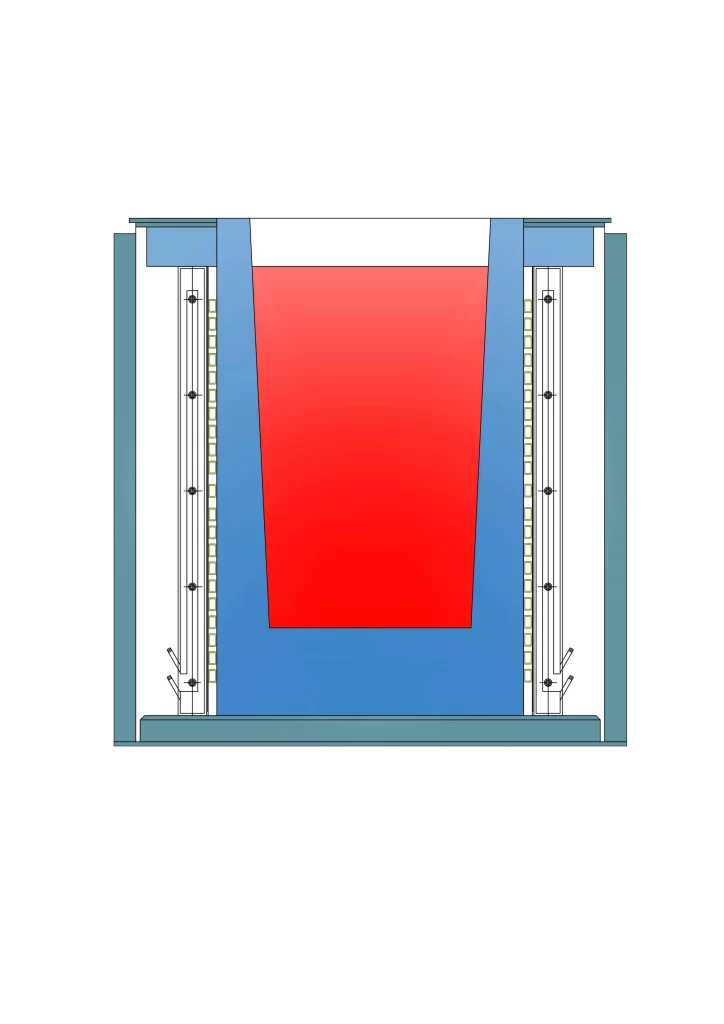
Induction furnace lining
The quality of the furnace lining is one of the key factors affecting the performance of a coreless induction furnace. Due to the limited familiarity of operators with induction furnaces, short lining lifespan is a common problem. This study utilizes a furnace-building process involving the application of different vibrators to tamp and dry-vibrate the lining, thereby improving lining lifespan, reducing labor intensity, and lowering production costs.
The materials used in this experiment include a furnace lining ejection mechanism, a furnace bottom pneumatic vibrator, a Jolter pneumatic hammer, a Martin pneumatic vibrator, lining material, mica paper, ceramic fiber cloth, a furnace-building crucible mold, a furnace bottom grounding device, thermocouples, tamping and degassing tools, a balance ruler, and other tools.
1.Removal of the old furnace lining
When the furnace lining is severely eroded and requires major repair, after the production task is completed, the electric furnace is air-cooled to room temperature, the furnace body is tilted to a horizontal position, and a hydraulic ejection mechanism is installed at the bottom ejection block to push out the old furnace lining. After removing the bottom ejection mechanism and straightening the furnace body, the iron sandwiched in the inner wall of the electric furnace is cleaned, and the furnace wall is repaired before use.
2.Repair of the burner nozzle
During prolonged use, the furnace nozzle is frequently damaged due to the scouring effect of molten iron. Therefore, before constructing the furnace lining, the furnace nozzle must be repaired first. This creates a vertical refractory material interface, reducing the likelihood of metal leakage from horizontal cracks below the nozzle.
3.Knotting at the bottom of the furnace
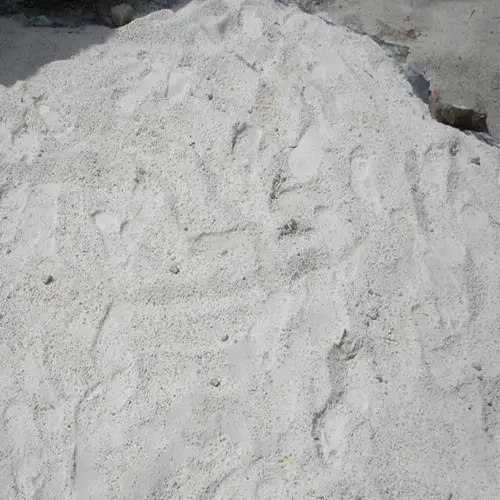
Remove the bottom ejector block from the old furnace lining and clean its surface with dry compressed air. Slowly place it into the bottom of the furnace. Install a grounding device at the small hole on the ejector block and secure it to the bottom. Lay a layer of ceramic fiber cloth on the ejector block and a layer of mica paper around it, close to the furnace wall, and secure it. Then, evenly pour in about 7 bags of dry vibrating material and place it in the pneumatic vibrator at the bottom of the furnace. Maintain a working air pressure of at least 0.6 MPa and vibrate for 30 minutes. Remove the vibrator and use a balance ruler to smooth the surface of the dry vibrating material until the grounding device probe is exposed.
4.Selection of furnace crucible mold
The furnace crucible mold is made of 6mm thick steel plate, with a material compatible with the metal being melted. Venting holes are evenly drilled around the perimeter, and the mold should be round with a slope of less than 5°. The surface should be smooth and rust-free, and welds should be polished. The thickness should be moderate. If the crucible mold is too thin, it will cause excessive heat dissipation and lower impact resistance, shortening the furnace lining life; if it is too thick, it will hinder induction heating and affect production efficiency.
5.Knotting and compaction of the furnace body
After the furnace bottom is tamped, place the furnace-building crucible mold smoothly into the furnace, ensuring concentricity. Then, evenly add 3-4 bags of dry vibratory material into the gap between the crucible mold and the furnace wall, simultaneously tamping and degassing with tamping and degassing tools. Throughout the entire process, it is strictly forbidden for foreign objects such as paper scraps to mix into the dry vibratory material.
Since the static pressing division uses a single power supply for two furnaces in its Yingda electric furnace, to ensure more comparable experimental results, a Jolter vibrator was used in furnace #1, and a Martin vibrator was used in furnace #2. The furnace bodies were vibrated separately for 2 hours each. Before vibration began, the crucible mold was fixed with a steel plate to prevent displacement during vibration. During vibration, the sinking of the dry vibratory material at the top of the furnace body should be constantly monitored, and dry vibratory material should be added to the surrounding area as needed until the dry vibratory material at the top of the furnace body stops sinking, at which point vibration should be stopped.
6.Sintering of furnace body
After the furnace body is sintered, pig iron is loaded, thermocouples are installed, and sintering of the furnace body begins. The sintering process is divided into three stages.
(1) First stage: The furnace charge is heated to 1000~1100℃ at a heating rate of 100℃/h. This stage needs to last for 9~10 hours, and the temperature is held for 3 hours within this range. The purpose of holding the temperature is to prevent cracks in the furnace lining due to excessive crystallization, to completely remove moisture from the dry vibrating material, and to achieve uniform temperature throughout the furnace lining.
(2) Second stage: Using induction energy, the initial furnace charge is heated at a rate of 100℃/h until 90% of the charge has melted. Charge is added again before complete melting, while avoiding bridging. In this stage, the temperature is held for 3 hours after reaching 1600℃, ensuring the furnace temperature does not exceed 1625℃. The purpose of this stage is to allow the furnace lining to initially form a sintered layer.
(3) Third stage: During high-temperature sintering, the structure formed by the sintering of the furnace lining directly affects its service life. Insufficient sintered layer thickness reduces service life. After sintering, power is turned off, and the furnace is cooled to the normal tapping temperature before production begins.