
Electric arc furnace
Broadly speaking, electric steelmaking furnaces include electric arc furnaces, induction furnaces, electroslag furnaces, and electron beam furnaces. Conventional electric furnace steel refers to steel produced in basic electric arc furnaces, hence this paper focuses on electric arc furnaces (EAFs). EAFs are categorized into direct current electric arc furnaces (DC-EAF) and alternating current electric arc furnaces (AC-EAF). DC-EAFs are gaining increased application and developing rapidly due to their advantages: reduced refractory consumption, greater energy efficiency, lower noise levels, and halved flicker. For DC-EAFs, technologies such as eccentric hearth tapping, water-cooled furnace walls, water-cooled furnace covers, oxygen-fuel burners, and scrap preheating are particularly suitable and effective. The 1990s marked a period of rapid advancement for DC-EAFs. Industrialized nations with high scrap recycling rates (such as the United States, Japan, and South Korea) and developing countries facing power supply constraints (like China and Southeast Asian nations) collectively installed over 100 electric arc furnaces exceeding 50 tons within a few years. Notable examples include Japan’s 240-ton DC-EAF and the United States’ 280-ton DC-EAF.
The DC arc furnace features a graphite electrode at the furnace top, producing a stable and concentrated arc. This design ensures excellent melt pool agitation and uniform temperature distribution within the furnace, thereby enhancing melting efficiency. A defining characteristic of the DC arc furnace is its configuration where the top graphite electrode serves as the cathode, while the anode is connected to the furnace bottom. This necessitates a conductive furnace bottom, with the primary conductive materials being: (1) Conductive refractory materials (ABB); (2) Metal components: including steel rod electrodes (Irsid-Clecim), steel plate electrodes (VAI), multiple steel needle electrodes (GHH), and copper-steel composite water-cooled bottom electrodes. Except for the special requirements for refractory materials used in the bottom of DC arc furnaces, the refractory materials used in other parts are highly similar.
The ultra-high-power electric arc furnace (UHP-EAF) is the most widely applied type of alternating current electric arc furnace (AC-EAF). This furnace offers high production efficiency, slow furnace wall wear, and advantages such as reduced melting time, improved thermal efficiency, lower power consumption, and stable arcs. Consequently, UHP-EAFs gained widespread adoption in the late 1970s. In recent years, UHP technology has evolved toward larger capacities and higher power ratings. Some foreign UHP-EAFs now reach 1000 kVA/t or higher, termed ultra-high-power electric arc furnaces. To better leverage UHP advantages, complementary technologies have been developed, primarily including water-cooled furnace walls, water-cooled furnace covers, and long-arc foam slag smelting techniques. All European electric arc furnaces above 30 tons are equipped with water-cooled slag-hanging furnace walls and water-cooled furnace covers. Over 70% of Japanese electric arc furnaces feature water-cooled furnace walls, while Western Europe and the United States have also adopted water-cooled slag-hanging furnace walls. Water-cooled furnace wall technology extends wall service life to over 2,000 furnaces, reduces refractory consumption by more than 60%, boosts productivity by 8%–10%, lowers electrode consumption by 0.5 kg/t, and cuts production costs by 5%–10%. Water-cooled furnace lids extend lid service life to 4,000 cycles.
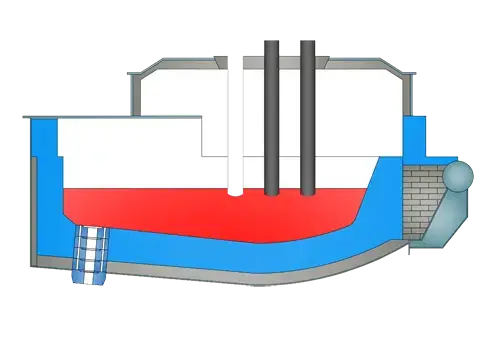
Electric furnaces can be classified by tapping type into channel-tapping electric arc furnaces and eccentric bottom tapping electric arc furnaces (EBT), whose structures are shown in Figure 1. The application of eccentric bottom tapping (EBT) furnaces is increasing due to their ability to expand the water-cooled zone, reduce refractory costs, and decrease slag removal from the ladle.
Electric arc furnace steelmaking uses scrap steel and metallized pellets as raw materials. It primarily relies on the heat generated by the electric arc, which reaches temperatures as high as 4000°C in the arc zone, to transform scrap steel into new steel through a series of metallurgical chemical reactions. The smelting process is generally divided into the melting phase, oxidation phase, and reduction phase. Within the furnace, both oxidizing and reducing atmospheres can be created, resulting in highly efficient phosphorus and sulfur removal.
China’s electric furnace steelmaking primarily focuses on producing high-quality alloy steel. In recent years, evolving electric furnace steelmaking processes—including higher operating temperatures, increasingly larger furnace capacities, more severe thermal shock, and continuously improving alloy steel quality—have placed greater demands on refractory materials.
More details about Electric arc furnace
What is the difference between electric arc furnace and induction furnace?
The primary difference between induction furnace and electric arc furnace is in their heating principle i.e., an induction furnace generates heat through electromagnetic induction, whereas an electric arc furnace produces heat by creating an electric arc between two electrodes.
Can virgin steel be made in an electric arc furnace?
Come to mention it, if you simply filled an electric arc furnace with DRI rather than scrap then technically speaking you’d be producing “virgin steel” rather than recycled steel. So even without any blast furnaces we can still, technically at least, make virgin steel.
How hot does an electric arc furnace get?
3,300 °F. Industrial electric arc furnace temperatures can reach 1,800 °C (3,300 °F), while laboratory units can exceed 3,000 °C (5,400 °F).
What is the main danger of an electric arc?
This phenomenon occurs when an electric arc causes a sudden release of electrical energy due to a fault, which can cause a bright flash and intense heat, leading to fires, explosions, and even severe injury or death to nearby personnel.
Which is better, a blast furnace or an electric arc furnace?
Energy and sustainability
In addition, electric arc furnaces also provide significant environmental and energy efficiency benefits. Compared to the blast furnace, an electric arc furnace achieves high energy savings.