
Furnace life, also known as lining life, refers to the total number of steel batches produced during a single operating cycle of a medium-frequency furnace lining, from the time it is put into service until it is replaced with a new lining. It serves as a comprehensive indicator of a medium-frequency furnace’s production performance. Therefore, the length of furnace life not only reflects the level of technical equipment, operational procedures, and production management but also determines the furnace’s productivity and production costs.
As is well known, medium-frequency furnaces are characterized by their compact size, light weight, rapid heating, and high efficiency. They are highly favored by foundries. They are primarily used to melt steel for castings and certain precision castings, and in recent years, they have also been used to melt stainless steel. At the same time, melting with a medium-frequency furnace can prevent the problems of sulfur and phosphorus enrichment, ensuring that the P content in the molten iron does not exceed 0.075% and the S content does not exceed 0.5%.
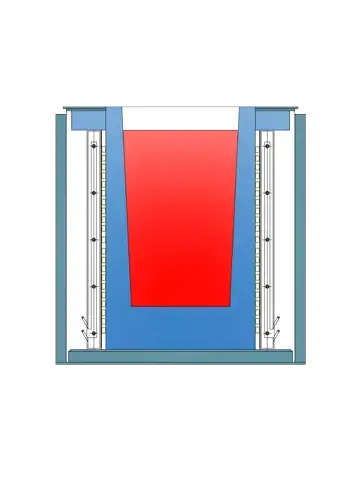
The refractory materials used in medium-frequency furnaces are relatively simple; typically, loose refractory mixes are employed, though some designs utilize crucibles (i.e., preformed furnace liners).
1. Select high-quality refractory materials suitable for smelting
As you are no doubt aware, furnace lining materials are indispensable in smelting and, in particular, casting. The chemical composition and physical and chemical properties of these materials have a significant impact on the service life of the furnace lining.
Currently, commonly used furnace lining materials can be broadly classified into three categories based on their chemical properties: acidic, basic, and neutral. Based on their physical properties, they can be divided into two categories: unshaped materials and shaped materials.
1.1 Properties of Furnace Lining Materials
The chemical composition, physical properties, and chemical characteristics of refractory lining materials have a significant impact on the service life of the lining. Impurities in refractory materials can form low-melting-point compounds at high temperatures, thereby reducing the refractoriness of the material. As the impurity content in refractory materials increases, their refractoriness decreases, and the service life of the lining also declines accordingly.
To extend the service life of the furnace lining, theoretically, the higher the purity of the refractory material, the better. However, in production practice, the availability of high-purity refractory materials is diminishing due to the depletion of mineral resources, while their prices continue to rise. To achieve a more ideal balance of cost-effectiveness and practicality for furnace lining materials, based on the actual conditions (physical and chemical properties) of commonly used, standard refractory materials for furnace linings, adding a certain amount of other materials to the refractory mixture can induce the formation of new compounds and derivative compounds at high temperatures. This approach effectively addresses the issue of refractory strength in furnace lining materials. In other words, by fully utilizing existing resources and further developing composite lining materials for application in actual smelting production, we can achieve better results.
Refractory materials of different compositions possess varying physical and chemical properties, which result in differing adaptability to smelting conditions—such as resistance to slag erosion and thermal shock resistance. Consequently, the service life of furnace linings varies significantly. In particular, when smelting high-manganese steel, not only are the smelting temperatures high, but the smelting conditions are also relatively harsh. Elements such as Fe, Si, Al, Mn, and C in the molten steel, as well as CaO, SO₂, and FeO in the slag, cause severe erosion of the furnace lining, thereby significantly reducing its service life.
Taking the smelting of high-manganese steel and high-carbon steel as examples, the quartz sand lining materials commonly used in daily operations are unable to withstand these demanding conditions. Due to the low refractoriness and high volumetric expansion rate of quartz-based acidic lining materials, their service life is short when used in steelmaking. However, because quartz sand is inexpensive, it is still used in cast iron smelting, particularly in continuous operations (where the crucible temperature is maintained between 800 and 1000°C), where its service life can exceed 100 batches. Consequently, nearly all foundries producing cast iron use quartz-based furnace lining materials. However, adopting dry ramming mixes such as magnesium, magnesium-aluminum, or magnesium-chromium (commonly referred to as alkaline furnace lining materials) can effectively address the issue of low refractoriness in lining materials.
2. Key Factors for Extending Furnace Life That Should Not Be Overlooked
2.1 The Effect of Volume on the Service Life of the Furnace Lining
The static pressure exerted by molten steel on the furnace lining varies depending on the size of the furnace. The service life of the furnace lining decreases as the furnace capacity increases.
Currently, most of the smelting equipment we use consists of non-vacuum induction furnaces. As furnace capacity increases, the static pressure exerted by molten steel on the furnace lining walls increases. Generally speaking, the static pressureed by the lining of a 1-ton furnace is 150 kg, while that of a 10-ton furnace is 500 kg. It is evident that the larger the furnace capacity, the greater the static pressure exerted on the furnace lining. Consequently, molten steel in large furnaces is more likely to penetrate the lining through the capillary channels of the refractory material, causing rapid deterioration of the lining. As furnace capacity increases, the frequency of the power supply decreases. Lower frequencies result in greater stirring forces, leading to higher impact forces on the furnace lining. The electromagnetic stirring force in molten steel is inversely proportional to the square root of the power supply frequency. The erosion force on the lining walls of a 3-ton furnace is 150 kg. Therefore, as furnace capacity increases, the erosion force on the lining walls also increases.
2.2 Effect of smelting temperature on the erosion of furnace lining materials
When the melting temperature exceeds 1700°C, the viscosity of the molten steel drops sharply, accelerating the rate of refractory lining deterioration and significantly reducing its service life. Therefore, proper control of the melting temperature directly affects the service life of the refractory lining.
It is evident, therefore, that adding a certain amount of other materials to magnesium-based refractories can effectively address the issue of thermal expansion in pure magnesium-based refractory linings.
2.3 Effect of Molten Steel Composition on Furnace Lining Service Life
Elements such as Fe, Si, Al, Mn, and C in molten steel—and even metal vapors and CO gas—as well as CaO, SiO₂, and FeO in the slag, migrate through the capillary channels of the refractory material and penetrate into its interior. These penetrating components deposit within the capillary channels of the refractory material, causing a discontinuity in the physicochemical properties of the working surface relative to the original refractory matrix. Under rapid changes in operating temperature, this leads to cracking, spalling, and structural loosening. Strictly speaking, this degradation process is far more severe than the dissolution-induced degradation process.
2.4 Erosion of the furnace lining by slag
As furnace capacity increases, the proportion of heat lost from the molten steel surface decreases. The slag temperature is higher than in smaller-capacity furnaces, and the slag has better fluidity, which intensifies erosion of the furnace lining. Large induction furnaces typically use the steel-slag mixed tapping method for tapping, which requires the slag to have good fluidity to meet the tapping conditions. Consequently, severe erosion occurs at the slag line, which is another factor contributing to the reduced service life of the furnace lining. Due to the reasons mentioned above, the service life of furnace linings in large induction furnaces is shorter than that of small and medium-sized induction furnaces. To extend the service life of the furnace lining, the thickness of the crucible lining should be appropriately increased. However, as the wall thickness of the furnace lining increases, the electrical resistance rises, leading to higher reactive power losses and a decrease in electrical efficiency. Consequently, the thickness of the furnace lining walls is limited to a certain range. Therefore, a reasonable wall thickness must be selected to ensure both high electrical efficiency and the service life of the lining.
The alkalinity of the slag must be compatible with the lining material. Magnesia-based lining materials are susceptible to erosion by high-CaO and SO₂ slags. The amount of CaF in the slag must be controlled; excessive CaF can erode alkaline linings, causing premature melting of the slag line zone.
Alkaline slags are suitable for magnesia linings, while acidic slags are suitable for quartz linings; magnesia-alumina linings can only be used with weakly alkaline or neutral slags. When the slag alkalinity is low, erosion of the magnesia lining is more severe, and the lining’s service life is consequently reduced; Conversely, when the slag alkalinity is high, erosion of the lining is milder, and the lining’s service life is relatively extended. When the concentrations of fluoride ions, manganese ions, and other elements in the slag are high, erosion of the magnesia lining is also more severe, and the lining’s service life is consequently reduced.
During slag-free smelting under vacuum, the service life of the furnace lining is longer than that during non-vacuum smelting.
This demonstrates that slag reduces the service life of the furnace lining. Therefore, the appropriate furnace lining material should be selected based on the properties of the slag.
2.5 The Effect of Lining Density on the Service Life of Furnace Linings
The compaction density of the furnace lining directly affects its service life. Therefore, while selecting the right lining material lays the foundation for extending service life, improving the compaction density of the lining is the key to achieving this goal.
To achieve a densely compacted lining (whether dry or wet compaction), the following points must be observed:
1. Compacting the furnace bottom: Fill and compact the material in three to four stages;
2. Compacting the furnace walls: Compact layer by layer, ensuring that the thickness of each layer does not exceed 15 centimeters;
3. After compacting each layer, the surface must be roughened before applying the next layer to ensure thorough bonding at the joints and completely eliminate the risk of delamination, particularly at the junction between the furnace bottom and the furnace walls.
4. Before ramming the furnace lining, the work area must be thoroughly and meticulously cleaned. Under no circumstances should iron-containing debris be mixed into the lining material. This prevents the formation of iron deposits or solidified iron—caused by the interaction of the lining material with iron impurities under the influence of electric potential—which could lead to furnace perforation.
The quality of the furnace lining directly affects the quality of the sintering process. During compaction, the sand particles must be uniformly distributed without segregation of coarse and fine grains, and the compacted sand layer must have high density. This reduces the likelihood of cracks forming after sintering and helps extend the service life of the crucible. The most common defects during compaction include low density, unevenness, and stratification of coarse and fine-grained sand (commonly referred to as particle size segregation). These issues are particularly evident when using low-moisture or dry compaction methods.
2.6 The Effect of Sintering Degree on the Service Life of the Furnace Lining
The compaction density of the furnace lining directly affects its service life, while the degree of sintering is the key factor determining its strength. Therefore, every aspect of the sintering process—from the heating rate in the low-temperature zone to the final sintering temperature and holding time—has a significant impact on the quality of the sintered lining. During low-temperature baking, the rate of water vapor escape must not be too rapid to prevent premature cracking in the sand mixture. The sources of moisture in the furnace lining include water adsorbed by the sand, crystalline water, and moisture released from the decomposition of additives; all of this moisture is expelled below 800°C. Therefore, the heating rate must be controlled within this range. The larger the furnace capacity, the lower the heating rate should be to prevent water vapor from escaping rapidly from the sand mixture. Different types of sand require appropriate sintering temperatures and holding times to achieve an ideal sintered structure. During high-temperature sintering, the sintered structure of the furnace lining is the foundation for extending its service life. Insufficient sintering temperature or inadequate thickness of the sintered layer will significantly reduce the service life of the furnace lining. To achieve a long-lasting furnace lining, an ideal sintered structure must be established in advance.
2.7 Furnace repair is one of the key measures for extending furnace life
After the furnace is fired up, the condition of the furnace lining must be checked frequently. If large cracks appear in the lining, they should be repaired immediately (small cracks do not require repair, as they will heal on their own under high-temperature conditions).
When repairing the furnace, first chisel away the surface layer of the damaged area, wash it with a 5% boric acid solution, then embed material identical to the furnace lining into the damaged area and tamp it down firmly with a rubber mallet.
After the furnace is shut down, cover the furnace top to prevent a sudden drop in the lining temperature. Rapid heating and cooling of the lining is akin to normalizing, which severely affects its microstructure and shortens its service life.
1) Improving the quality of refractory lining materials is fundamental; key factors in extending furnace life include ensuring a dense and well-compacted lining, optimizing the steelmaking process, lowering the steelmaking temperature, and performing timely furnace repairs.
2) The proper use of appropriate amounts of binders, adhesives, and additives will also improve the overall quality of the refractory lining. For example, adding a certain proportion of high-alumina materials to magnesia-based lining materials to form the magnesium-aluminum spinel phase under high-temperature conditions also helps extend the lining’s service life.
3) Extending furnace life can reduce production costs, increase output, and alleviate workers’ labor intensity. It also drives and promotes advancements in production technology and management.