
1.Clay brick
Clay bricks are refractory materials with an Al₂O₃ content of 30% to 48%, made using fired clay aggregates and refractory clay (plastic or semi-plastic clay) as a binder. They are the most widely used and highest-volume refractory products.
The properties of clay products vary significantly, due to differences in their chemical composition and manufacturing processes. Clay products generally exhibit the following properties:
(1) Chemical and mineral composition. The Al₂O₃ content ranges from 30% to 48%, the SiO₂ content from 50% to 65%, and it contains small amounts of alkali and alkaline earth metal oxides, TiO₂, Fe₂O₃, and others. The mineral composition generally consists of mullite, cristobalite, quartz, and a glass phase.
(2) The refractoriness is generally 1580–1750°C, increasing as the Al₂O₃/SiO₂ ratio rises; however, the refractoriness of the product decreases significantly when the content of low-melting impurities is high.
(3) The load-bearing softening temperature is approximately 1250–1450°C, with a relatively wide variation range. The initial deformation temperature is low, differing by about 200–250°C from the 40% deformation temperature.
(4) The coefficient of linear expansion is low, and thermal conductivity is also low.
(5) It exhibits good thermal shock resistance, with a relatively wide range of tolerance. It generally withstands more than 10 water-cooling cycles at 1100°C. This is attributed to the low coefficient of linear expansion of clay-based products, the insignificant effect of crystalline phase transformation, and their plasticity at high temperatures.
(6) Resistance to chemical erosion: As it is weakly acidic, it possesses strong resistance to erosion by acidic slags but has weaker resistance to erosion by alkaline substances.
Clay refractories are acidic refractory products whose acidity increases with rising SiO₂ content. They exhibit a certain degree of resistance to erosion by acidic slag but are less resistant to erosion by alkaline slag; therefore, clay refractories are suitable for use as linings in acidic furnaces. They are also used in high-temperature furnaces such as blast furnaces, hot blast stoves, glass furnaces, and carbon calcining furnaces.
2.High-alumina brick
The production process for high-alumina products is similar to that for clay-based products made with multiple clinker types. The specific production process should be determined based on actual production conditions, raw material characteristics, product requirements, and other factors. This involves strictly grading clinker lumps prior to crushing, storing graded granular material separately and removing iron, and finely grinding the mixture of clinker and binding clay.
The characteristics of high-alumina products are as follows:
(1) Load-bearing softening temperature. The load-bearing softening temperature of ordinary high-alumina refractory products is generally 1420–1550°C or higher, which is higher than that of clay-based refractory products, and increases with rising Al₂O₃ content. When Al₂O₃ < 70%, the load-bearing softening temperature increases with the increase in the ratio of the mullite phase to the glass phase. The quantity and properties of the liquid phase have a significant effect on the load-bearing softening temperature; therefore, reducing the impurity content in the raw materials helps improve the load-bearing softening temperature and high-temperature creep resistance. When Al₂O₃ > 70%, the load-softening temperature does not increase significantly with increasing Al₂O₃ content.
(2) Thermal shock resistance. The thermal shock resistance of ordinary high-alumina refractory products primarily depends on their chemical and mineral composition and microstructure. Generally, it is inferior to that of clay products.
(3) Resistance to chemical erosion. Ordinary high-alumina refractory products exhibit good resistance to erosion by acidic or alkaline slags and molten metals, as well as to oxidation and reduction reactions. This resistance increases with higher Al₂O₃ content and lower levels of harmful impurities.
High-alumina products are generally used in industrial furnaces such as blast furnaces, hot blast stoves, and electric furnaces.
High-alumina bricks are classified into several grades based on their physical and chemical properties, including LZ-80, LZ-75, LZ-65, LZ-55, and LZ-48.
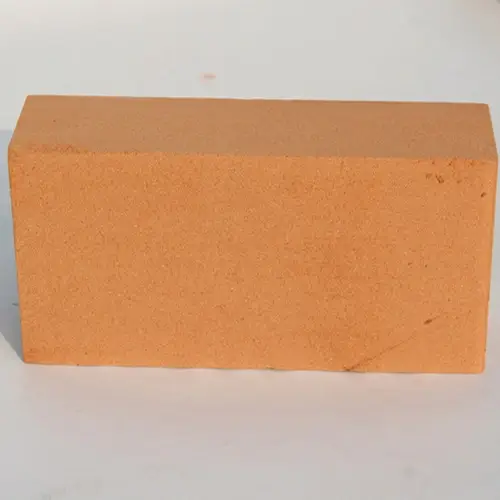
3. Lightweight Clay Bricks (Clay Insulation Bricks, Clay Thermal Insulation Bricks)
Lightweight clay bricks refer to lightweight refractory products containing 30% to 46% Al₂O₃. They are primarily made from clay sintered material or lightweight sintered material combined with plastic clay. They are typically produced using the combustible method, though the chemical method or the foaming method may also be used to create a porous structure. The raw materials are mixed with water to form a plastic slurry or paste, which is then shaped by extrusion or casting. After drying, the product is fired in an oxidizing atmosphere at 1250–1350°C. Common lightweight clay bricks have a bulk density of 0.75–1.20 g/cm³ and a compressive strength of 2.0–5.9 MPa. Lightweight clay bricks have a wide range of applications and are primarily used as insulation materials in various industrial furnaces where they do not come into contact with molten materials or corrosive gases, with operating temperatures ranging from 1200 to 1400°C. The Chinese standard (GB 3994-1983) classifies these bricks into ten grades based on bulk density: NG-1.5, NG-1.3a, NG-1.3b, NG-1.0, NG-0.9, NG-0.8, NG-0.7, and NG-0.6.
4.Lightweight high-alumina bricks
Lightweight high-alumina bricks generally refer to various types of lightweight refractory products containing more than 45% Al₂O₃. They are typically divided into two categories: ordinary lightweight high-alumina bricks, which are manufactured using natural high-alumina bauxite clinker as raw material; and high-quality lightweight high-alumina products, which are manufactured using electrofused or sintered alumina as raw material. Because their primary crystalline phase is corundum, these are also known as lightweight corundum bricks.
Lightweight high-alumina bricks are generally produced using the foam method. The clinker is ground and mixed with a binder (such as clay) and a foaming agent to form a slurry, which is then poured into molds and fired at 1350–1500°C. Typical lightweight high-alumina bricks have a bulk density of 0.4–1.35 g/cm³, a porosity of 66%–73%, a compressive strength of 1.3–8.1 MPa, and a thermal conductivity of 0.291–0.582 W/(m·K) at 350°C. Lightweight high-alumina bricks have high refractoriness and good thermal shock resistance, and are commonly used as high-temperature insulation layers in kilns and furnaces. High-quality lightweight high-alumina bricks can be used for furnace linings in direct contact with flames, but are not suitable for applications subject to direct slag erosion. Due to their good chemical stability in reducing atmospheres, lightweight high-alumina bricks are generally used as insulating linings in kilns employing protective atmospheres such as hydrogen or carbon monoxide. The operating temperature range for lightweight high-alumina bricks is 1350–1500°C, while high-purity products can withstand temperatures up to 1650–1800°C. According to Chinese standards, lightweight high-alumina bricks are classified into several grades based on bulk density, including LG-1.0, LG-0.9, LG-0.8, LG-0.7, and LG-0.6.
5.Mullite lightweight bricks
Mullite-based lightweight bricks are a new type of high-quality thermal insulation refractory material containing 50% to 85% Al₂O₃, with mullite (3Al₂O₃·2SiO₂) as the primary crystalline and binding phase. Due to mullite’s excellent high-temperature mechanical properties and chemical stability, mullite-based lightweight bricks exhibit superior performance characteristics, including high structural strength at high temperatures, low high-temperature creep rates, low thermal expansion coefficients, strong resistance to chemical erosion, and good thermal shock resistance. They can be used as linings for furnace working surfaces in direct contact with flames, significantly improving the energy efficiency of the furnace. The operating temperature range of mullite-based lightweight bricks varies from 1350°C to 1700°C, depending on the product’s alumina content and bulk density.